What is the Kappa Opioid Receptor?
The OPRK1 gene contains a critical kappa opioid receptor (see below). This receptor is commonly studied with the synthetic U69,593 or U50,488 agonists, which are molecules that bind to and activate the receptor. These agonists are often used in experimental settings to better understand how the KOR functions and how activation affects signaling pathways. By activating the receptor, researchers can observe how the KOR influences neural communication, stress responses, and pain perception.
As a receptor for endogenous ligands, molecules produced inside the body, the kappa opioid receptor on OPRK1 binds to these synthetic agonists along with opioids made in the body for natural function. Ligand binding tends to inhibit adenylate cyclase activity and neurotransmitter release, which in turn affects pain perception. This occurs because inhibition reduces signaling between neurons. As a result, the body begins to change how it responds to chronic, neuropathic, and inflammatory pain rather than addressing the source of the pain itself. Over time, repeated activation of this pathway may also contribute to longer-term changes in signaling and response to stress.
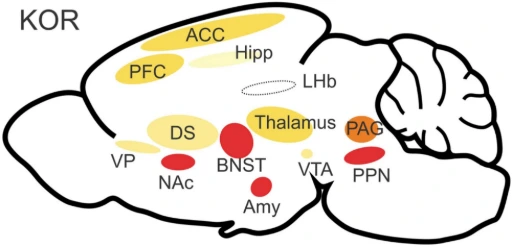
Signaling Pathways and Molecular Components
All opioid receptors are G-protein coupled receptors, implying that they all use G proteins Gαi and Gβγ along with mitogen-activated protein kinases (MAPK) in arrestin signaling pathways. These shared signaling components allow opioid receptors to influence neurotransmitter release and cellular communication. An arrestin signaling pathway is when β-arrestin 1 or 2 proteins bind to activated G-protein receptors to form a ‘scaffold’ combining various kinases that activate a MAPK cascade. The signaling cascade converts growth factors into extracellular signals, allowing communication between intracellular activity and broader physiological responses. These pathways may also contribute to long-term changes in signaling when receptors are activated repeatedly.


Role in Stress and Mood Regulation
The KOR plays a significant role in stress and mood regulation by directly interacting with dopamine neuron terminals, as stated by current research. When activated, the KOR can suppress dopamine release, which contributes to reduced reward perception and negative emotional responses. This suppression can also influence behavior and contribute to long-term changes when activation occurs repeatedly.
Furthermore, research appears to support ligand bias towards pathways in KOR receptors. Thus, different ligands will be able to cause different protein kinase cascades, resulting in varied biological outcomes depending on the activating molecule. This concept suggests that certain ligands may activate beneficial pathways while limiting negative effects, making this an important area for further research.
AZ-MTAB Antagonist
Furthermore, peer-reviewed research suggests that antagonist AZ-MTAB (see below) can inhibit kappa opioid receptors when administered before the ligand reaches the KOR. This antagonist could prevent patients from feeling the effects of opioids, indicating a potential role in addiction prevention strategies. However, it has not yet been proven via clinical trials. This highlights a potential avenue for future research and underscores the need for additional testing to assess effectiveness and safety.

Definition and Physiological Basis
Opioid dependence is the process by which one becomes addicted to opioids. It is a form of drug tolerance, meaning that repeated exposure alters the body's normal physiological balance. Over time, the body adapts to opioid exposure, resulting in changes to neurotransmitter signaling. What this means is that opioids become necessary for the overall homeostasis of the body. Opioid overuse causes a slow deterioration, which begins making the body reliant on excessive amounts of opioids. This dependence develops gradually as repeated use changes normal signaling patterns.
This leads to the need for higher quantities to feel the same euphoric effect that would have been experienced from a normal dose. Over time, this escalation becomes a defining characteristic of addiction and increases the risk of long-term consequences. So what role does the kappa-opioid receptor play in this?

Dopamine Transport and KOR Interaction
Opioid dependence has profound effects on biological pathways. The dopamine transporter (DAT) appears to interact with the KOR, influencing dopamine transmission. Specifically, KOR agonist salvinorin A appears to increase the uptake of dopamine in relation to DAT when opioids are administered. Therefore, there is less dopamine remaining in the synaptic cleft, reducing reward signaling.
Furthermore, in terms of consistent activation of the KOR, there is a net decrease in dopamine signaling. This alludes to the idea that excessive opioid usage eventually leads to a necessity of overuse to feel the same effect as one might experience when using opioids initially. This occurs because reduced dopamine signaling weakens the activation of the reward pathway. In turn, there is little reward from drug use, ensuring that individuals must use larger drug quantities to feel the same way they had originally felt.
This also causes individuals to continue chasing the same feeling. This is known as drug dependence or tolerance. Overall, KOR hyperfunctioning and stress exposure lead to low synaptic dopamine levels in the long term, contributing to persistent behavioral changes.